Corporate Reputation Management: How to Choose the Right Social Media Listening Tool

Why is Corporate Reputation Management Important?
Negative public perception can erode a company’s reputation in an instant. In the fast-moving world of online media, one misleading headline or viral social post, fake or real, can amplify negative sentiment and undermine user trust. That’s why protecting corporate reputation and using social media listening tools to maintain it are crucial for the longevity of your business.
What is Corporate Reputation Management?
Simply put, corporate reputation management is the ongoing effort to shape and protect an organization’s overall image. It involves every stakeholder, such as employees, customers, investors, and the public. While specific departments like marketing, PR, branding, and crisis management handle short-term initiatives, reputation management provides long-term guidance to maintain trust and a positive public image.
Components of Corporate Reputation Management
A company’s reputation is shaped by several interconnected factors, such as:
- Social Responsibility: upholding the values and goals stated in the company’s mission
- Workplace Culture: fulfilling agreements and offering fair treatment to employees
- Customer Experience: delivering the promised product and exceeding client expectations
- Online Visibility: keeping a strong presence in search results and across digital platforms
Real-Life Success and Failure stories
Airbnb’s Response to Covid-19
In March 2020, during the Covid-19 epidemic, Brian Chesky—Airbnb’s Co-Founder, CEO and Head of Community—established a $250 million fund to reimburse hosts for cancelled reservations. In addition, the company enforced stronger cleaning guidelines for listings. In the midst of the global pandemic, Airbnb’s timely response and financial support showed they cared about their users. In terms of reputation, this elevated positive sentiment and trust, ultimately strengthening long-term loyalty.
Abercrombie & Fitch’s Absent Response to Exclusivity
In May 2013, Abercrombie & Fitch faced backlash for remarks criticizing larger-sized women wearing their clothes. In response, the company chose silence, which consumers perceived as a failure to take responsibility for their mistakes. An investor withdrew their financial support, as negative sentiment spiked among stakeholders. Abercrombie & Fitch then issued a public apology, but it was too late; profits fell, reinforcing the impression that the company valued profit over community.
The stark contrast with Airbnb’s proactive crisis response demonstrates how critical reputation management can be for a company’s long-term resilience.
Step-by-Step Guide for a Strong Corporate Reputation Management Strategy
Building an effective corporate reputation strategy starts with adopting a proactive mindset by embedding awareness and accountability into your work culture, social responsibility, and customer experience.
Social media listening tools play a key role in this approach, helping companies detect risks before they escalate.
Here is a brief step-by-step guide to developing a corporate reputation management system using social media listening tools.
1. Monitor and audit daily
Use media monitoring and social listening tools to survey news, forums, social posts, and other online platforms where your brand is discussed. Choose tools that can easily filter out relevant mentions from online noise.
Daily monitoring and tracking will help you understand your brand’s overall public perception.
2. Identify and assess risks
As you monitor public perception, social listening tools can help identify unusual spikes in conversation volume or sentiment, highlighting the signals that may require your attention and action.
3. Intentional Engagement and Response
Once your listening tools have helped you surface and prioritize information, it’s time to evaluate how and when to engage with the conversation. In general, audiences trust brands that respond within a consistent timeframe.
The expected response time may depend on the severity of the issue. For example, an emerging crisis is a high priority, while a positive comment is a low priority. In every case, authentic and intentional engagement is important for sustaining public trust.
4. Prove Change and Improvement
After assessing public perception and responding when needed, the focus should move on to implementing meaningful improvements. These may involve any area of reputation management, from refining your messaging to strengthening long‑term relationships with key stakeholders.
5. Continuous Monitoring and Improvement
Reputation management is a continuous process. As your company evolves, keep an eye on shifts in public perception, identify opportunities for improvement, and try to anticipate emerging crises. This day-to-day approach to monitoring will strengthen resilience and support long-term business growth.
How to Choose the Right Social Listening Tool
Choosing the right social media tool can depend on factors such as company size, budget, and goals. Additionally, it is important to understand the social platforms relevant to your users.
Each tool provides unique functions which may or may not be useful to your business. For instance, some track real-time alerts which are helpful in crisis management, while others track historical insights for companies interested in deep research.
Below are examples of social listening tools for different company profiles:
1. ReadPartner

ReadPartner is a media monitoring platform with a comprehensive social media listening suite that works across company sizes and budgets. It utilizes advanced monitoring algorithms to sift through noise and identify important updates about your public image. These tools include:
- Real-Time Alerts to detect anomalies in social media and news outlets
- Noise filtering to separate content that matters from content that does not
- Context analysis that visualizes sentiment, political bias, source distribution, and key authors through graphs and charts, creating a comprehensive understanding of public perception
These capabilities help decision-makers reduce reputational risk, streamline workflows, and deliver stakeholder-ready reports.
Who is this for: Companies of all sizes seeking corporate reputation management across social platforms including X, Instagram, Reddit, Bluesky, LinkedIn, and YouTube.
Price: Available upon requesting a demo.
2. Brandwatch
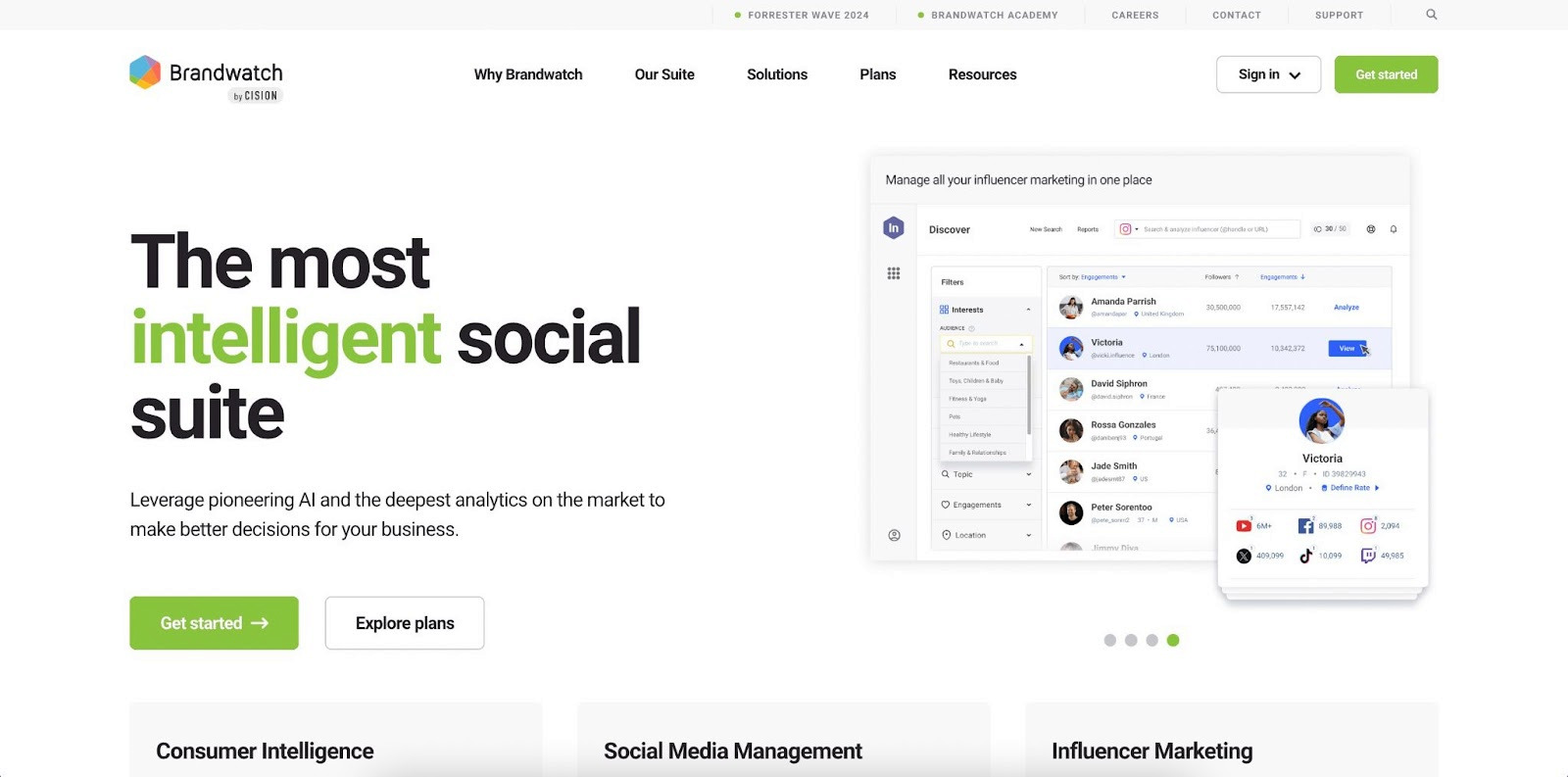
Brandwatch is a social media suite which includes listening tools.
Its features include sentiment analysis, crisis monitoring, scheduled reports, and data tracking. These tools are geared towards enterprises, not smaller businesses.
Who is it for: Enterprises seeking in-depth sentiment analysis and content management.
Price: Available upon request.
3. Later
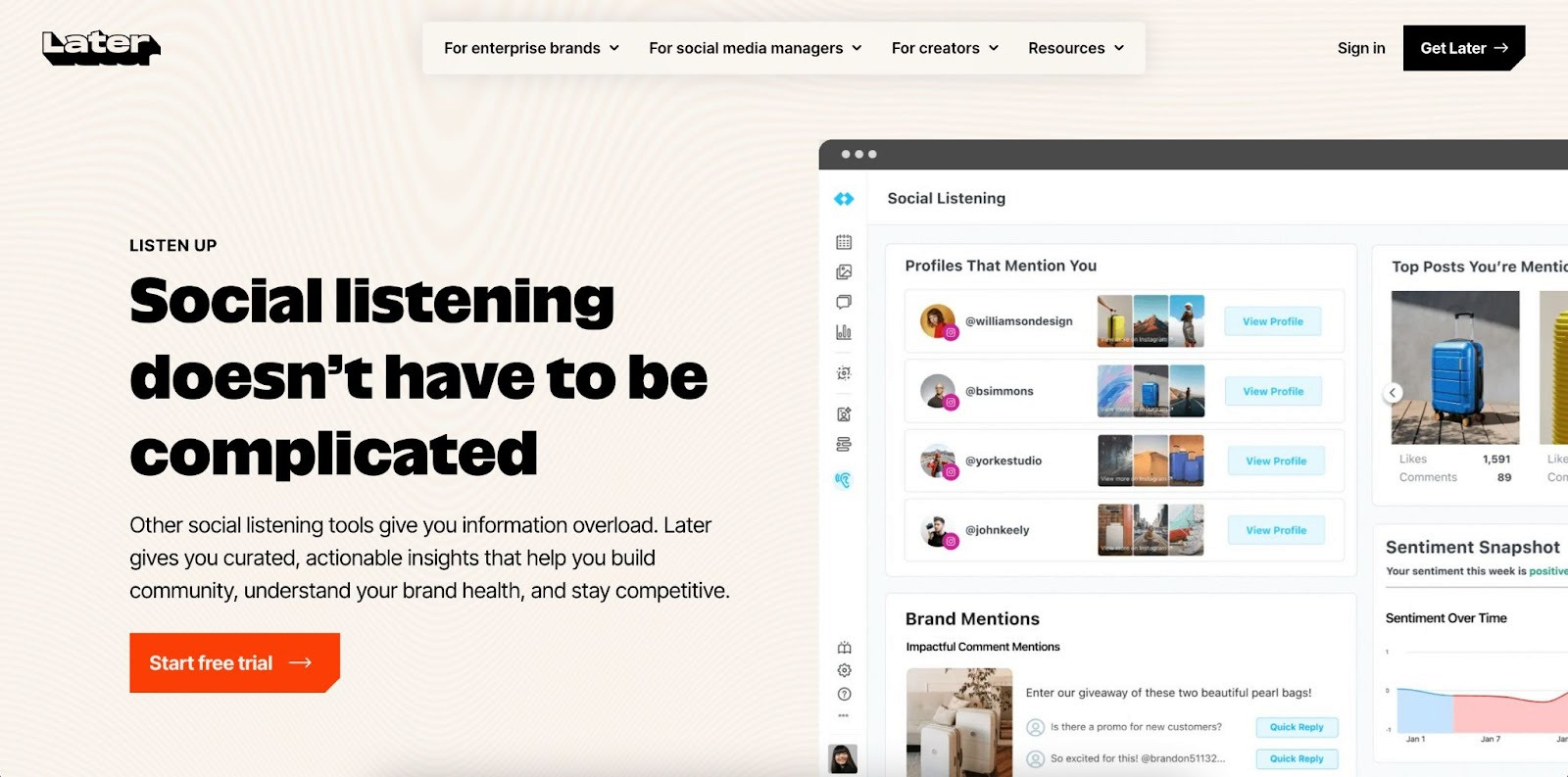
Later is a social media management platform with listening tools for all major platforms, including Instagram, Facebook, TikTok, and LinkedIn.
Its social listening tools detect sentiment, mentions, and more. There are features available for both enterprises as well as social media managers.
Who is this for: Small to mid-sized companies and individual content creators seeking a budget-friendly listening suite.
Price: Starting at $18.75 per month for an individual user.
Key Takeaways
Effective corporate reputation management is essential to long-term resilience. Staying true to your mission and values, while maintaining transparency with stakeholders, is the key to building lasting trust. Social media listening tools can help you understand public perception, monitor and evaluate risk, and identify areas for improvement.
Choosing the right platform starts with identifying your organization’s goals and the specific features that meet them. A solid, well-structured strategy and carefully selected tools will help you sustain your reputation over time.
While there are many options, ReadPartner offers a comprehensive social media listening suite designed to adapt across industries and company sizes. With its strong analytics and reporting features, it can help decision-makers improve workflows, reduce reputational risks, and respond to crises in an effective and timely manner.
FAQ
Should companies invest in a social media listening tool?

Yes. As reputational risks can escalate quickly, companies with an online presence should consider investing in such tools, as they can help identify and manage potential issues before they become bigger crises.
How do social media listening tools help decision-makers and stakeholders?
The best social media listening tools not only capture what is being said online, but also synthesize and graph context, sentiment, and other data to steer stakeholders and decision-makers to the right course of action.
How can companies choose the right social media listening tool?
Start by evaluating your goals, needs and budgets. Then compare platforms based on coverage, features, and usability. Most providers, such as ReadPartner, offer demos for you to test how each solution fits your organization's specific requirements.
Sources
- https://news.airbnb.com/a-letter-to-hosts/
- https://brand24.com/blog/corporate-reputation-management/
- https://eloncdn.blob.core.windows.net/eu3/sites/153/2017/06/07_Isabel_Koehler.pdf
- https://www.reputationdefender.com/blog/orm/what-is-corporate-reputation-management-a-guide-to-protecting-your-brands-image
- https://blog.hootsuite.com/social-listening-tools/
- https://mention.com/en/
- https://thecmo.com/tools/best-social-media-reputation-management-tools/
- https://www.reputationx.com/blog/corporate-reputation-strategy